
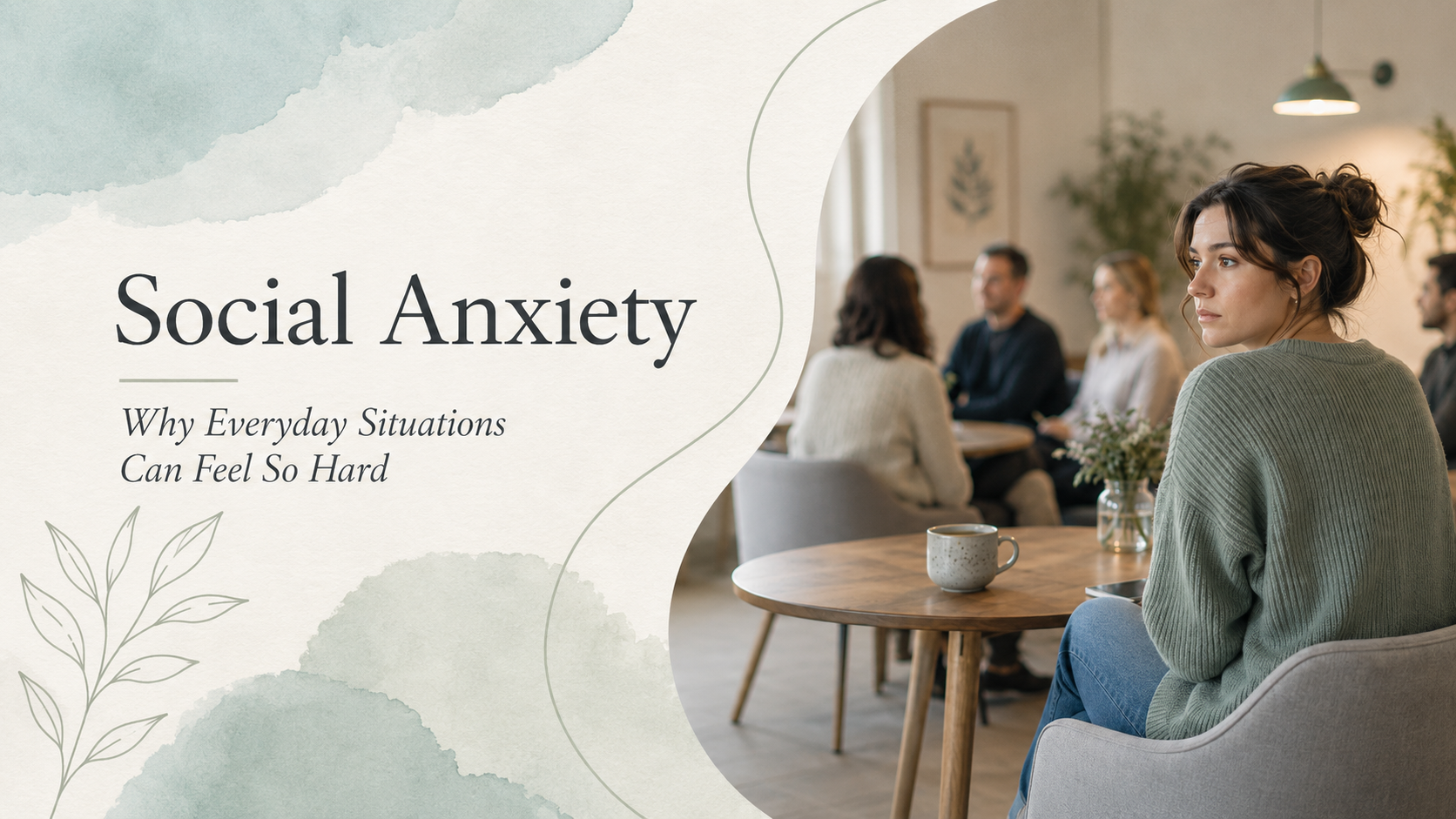
Talking to new people. Walking into a room alone. Speaking in a group. Making a phone call. Asking a question.
These things may seem simple, but for someone with social anxiety, they can feel very hard.
Social anxiety is more than being shy. It is a strong fear of being judged, embarrassed, rejected, or noticed in a negative way.
The fear can be so strong that even small social situations can feel stressful.
What Does Social Anxiety Feel Like?
Social anxiety can affect both your thoughts and your body.
You may think:
- “What if I say something stupid?”
- “What if they do not like me?”
- “What if I look nervous?”
- “What if everyone is watching me?”
- “What if I embarrass myself?”
Your body may also react.
Your heart may beat faster. Your face may feel hot. Your hands may shake. Your stomach may feel upset. You may feel tense, dizzy, or sweaty.
These feelings can make you want to leave the situation or avoid it completely.
Why Does This Happen?
Your brain is built to look for danger.
Sometimes it reacts to social situations as if something bad is about to happen.
Even when you are not in real danger, your brain may send out a warning signal.
That warning can make your body prepare to protect you.
This is one reason social anxiety can feel so powerful.
Your brain may be trying to keep you safe, but it can become too sensitive.
Why Avoiding Things Can Make Anxiety Stronger
Avoiding a stressful situation can feel good at first.
You may feel relieved when you cancel plans, stay quiet, avoid eye contact, or decide not to go.
But that relief can teach your brain something.
It can teach your brain, “Good thing we avoided that. It must have been dangerous.”
This can make the fear stronger the next time.
Over time, your world may start to feel smaller.
You may avoid more people, places, or activities, even when part of you wants to join in.
The Overthinking That Comes After
Social anxiety does not always end when the situation ends.
Many people replay conversations afterward.
You might think:
“Why did I say that?”
“Did I sound weird?”
“Were they annoyed with me?”
“Did I talk too much?”
“Did I not talk enough?”
This can go on for hours.
Your mind may focus on every small detail and ignore the parts that went fine.
This can make normal social moments feel much worse than they really were.
People Are Usually Paying Less Attention Than You Think
When we feel anxious, it can seem like everyone is watching us.
But most people are thinking about themselves.
They may be wondering what they should say, how they look, what they need to do next, or whether they are making a good impression too.
That does not mean your fear is silly.
It means anxiety can make the spotlight feel much brighter than it really is.
Social Anxiety Can Show Up in Different Ways
Social anxiety does not look the same for everyone.
Some people avoid parties or large groups.
Others are okay with friends but feel nervous at work or school.
Some people struggle with phone calls, meetings, dating, eating in front of others, or speaking to people they do not know.
Some people are very talkative but still feel anxious inside.
You do not have to look shy to have social anxiety.
Small Steps Can Help
You do not have to force yourself into the hardest situation right away.
Small steps can help your brain learn that social situations are not always dangerous.
You might start by saying hello to someone.
You may ask one question in a group.
You might make one short phone call instead of avoiding it.
You may stay at an event for 20 minutes instead of leaving right away.
Each small step gives your brain new information.
It learns, “I felt nervous, but I got through it.”
That matters.
Try Not to Wait Until You Feel Completely Ready
One tricky part of anxiety is that people often wait to feel confident before doing something.
But confidence often comes after practice.
You may still feel nervous the first few times.
That does not mean you are doing it wrong.
The goal is not always to make anxiety disappear.
The goal can be learning that you can handle the feeling without letting it make every decision for you.
Therapy Can Help With Social Anxiety
Therapy can help you understand the thoughts and fears behind social anxiety.
It can also help you notice habits that may be keeping the anxiety strong.
For example, you may always rehearse what to say, avoid eye contact, leave early, or stay very quiet so no one notices you.
These habits may feel helpful, but they can sometimes keep the fear going.
A psychologist can help you practise new ways of responding.
You can also learn tools for handling anxious thoughts, building confidence, and facing situations at a pace that feels manageable.
You Do Not Have to Become a Different Person
Getting help for social anxiety does not mean you need to become the loudest person in the room.
You do not need to love parties.
You do not need to enjoy public speaking.
You do not need to change your personality.
The goal is to have more freedom.
It means being able to speak, connect, ask questions, try new things, and make choices without fear controlling everything.
Social Anxiety Can Get Better
Social anxiety can make everyday life feel exhausting.
But it can improve.
With practice, support, and the right tools, social situations can begin to feel more manageable.
You may still feel nervous sometimes.
That is normal.
What can change is how much power that fear has over your life.
At Calgary Mental Health & Wellness Centre, our psychologists support people who are dealing with anxiety, stress, confidence concerns, and other challenges.
You do not have to wait until social anxiety is stopping you from doing the things you care about.
Sometimes one small step is enough to start changing the pattern.
